









Electricity pricing is becoming more time-based and flexible in many markets. As renewable energy, electric vehicles, heat pumps, data centers and industrial electrification increase electricity demand, utilities and energy suppliers need better ways to encourage consumers to shift electricity use away from peak periods.
This is why dynamic electricity tariffs, time-of-use tariffs and demand response are becoming closely connected with smart metering. According to the IEA’s Electricity 2026 analysis, global electricity demand is expected to grow strongly from 2026 to 2030, and meeting forecasted demand will require much greater investment in grids and flexibility. The IEA also emphasizes the need for greater grid flexibility and more efficient use of existing power systems as electricity demand grows.
For utilities, AMI project buyers, system integrators, meter brands and energy service providers, this trend creates a practical question:
What data capabilities should a smart meter provide for tariff-based electricity management?
The answer starts with reliable metering hardware, accurate time-based data, stable communication and proper integration with the utility billing system, HES, AMI platform or customer-side software.
Why Electricity Tariffs Are Becoming More Dynamic
Traditional electricity tariffs are often fixed or simple. However, modern power systems are becoming more variable. Solar and wind generation can change throughout the day. Peak demand can rise quickly when cooling, EV charging or industrial loads increase. Grid operators and energy suppliers therefore need more flexible tools to balance supply and demand.
Dynamic tariffs and time-of-use tariffs are designed to reflect electricity cost differences across different time periods. A time-of-use tariff may define different prices for peak, off-peak and shoulder periods. A more dynamic tariff may change more frequently according to market prices or system conditions.
In the EU, dynamic electricity pricing is closely linked with smart meter availability. The Florence School of Regulation explains that EU rules allow final customers with a smart meter to conclude a dynamic electricity price contract with at least one supplier in their market, and with every supplier that has more than 200,000 final customers.
This does not mean every country uses the same tariff model. Dynamic tariff, time-of-use tariff and billing rules vary by local market. But it does show one important point: smart meters are becoming part of electricity market flexibility infrastructure, not only remote reading devices.
What Is a Multi-Tariff Smart Meter?
A multi-tariff smart meter is a meter that can record or support electricity consumption according to different tariff periods or tariff registers. Depending on the meter design and project requirement, it may support functions such as:
- Time-of-use tariff registers
- Peak and off-peak energy measurement
- Multiple tariff periods
- Import and export energy measurement by model
- RTC-based time management by model
- Load profile data by model
- Remote reading by AMI or communication systems
- Prepaid or postpaid tariff-related applications by project
A multi-tariff smart meter does not decide electricity prices by itself. It provides metering data according to the tariff logic configured in the meter, utility system or external platform. Final billing usually depends on the utility billing system, HES, AMI platform, prepaid vending system or customer-side software.
For real-time or frequently changing dynamic tariffs, the meter alone is usually not enough. The project also needs reliable time synchronization, interval data, communication with the HES or billing system, and clear tariff rules defined by the utility or energy supplier.
This boundary is important. A meter can support tariff data collection, but tariff rules, settlement logic and customer billing must be defined by the local market, utility or project system.
How Smart Meters Support Time-of-Use and Dynamic Pricing
Smart meters support tariff-based electricity management by recording when electricity is used, not only how much electricity is used.
For a simple energy meter, total kWh may be enough. For time-of-use or dynamic tariff projects, the system usually needs more structured data, such as:
- Energy consumption by time period
- Load profile interval data
- Date and time synchronization
- Import and export energy values
- Event logs
- Tariff registers
- Remote reading data
- Communication with HES or AMI systems
For example, if a utility wants to apply different prices for peak and off-peak periods, the meter or AMI system must identify which energy consumption belongs to each tariff period. If a demand response program needs to evaluate customer load changes, interval data and reliable timestamps become important.
In some markets or projects, interval data may be hourly, 30-minute, 15-minute or another defined interval. The required interval should always be confirmed according to local market rules, project requirements and the utility system.
This is why smart metering is closely connected with dynamic pricing and demand response. The meter provides the data layer, while the upper-level system applies tariff rules, pricing logic and customer communication.
Meter Data Requirements: Time Interval, Accuracy and Communication
Project buyers should not select a tariff meter only by product name. They should confirm the actual data and communication requirements.
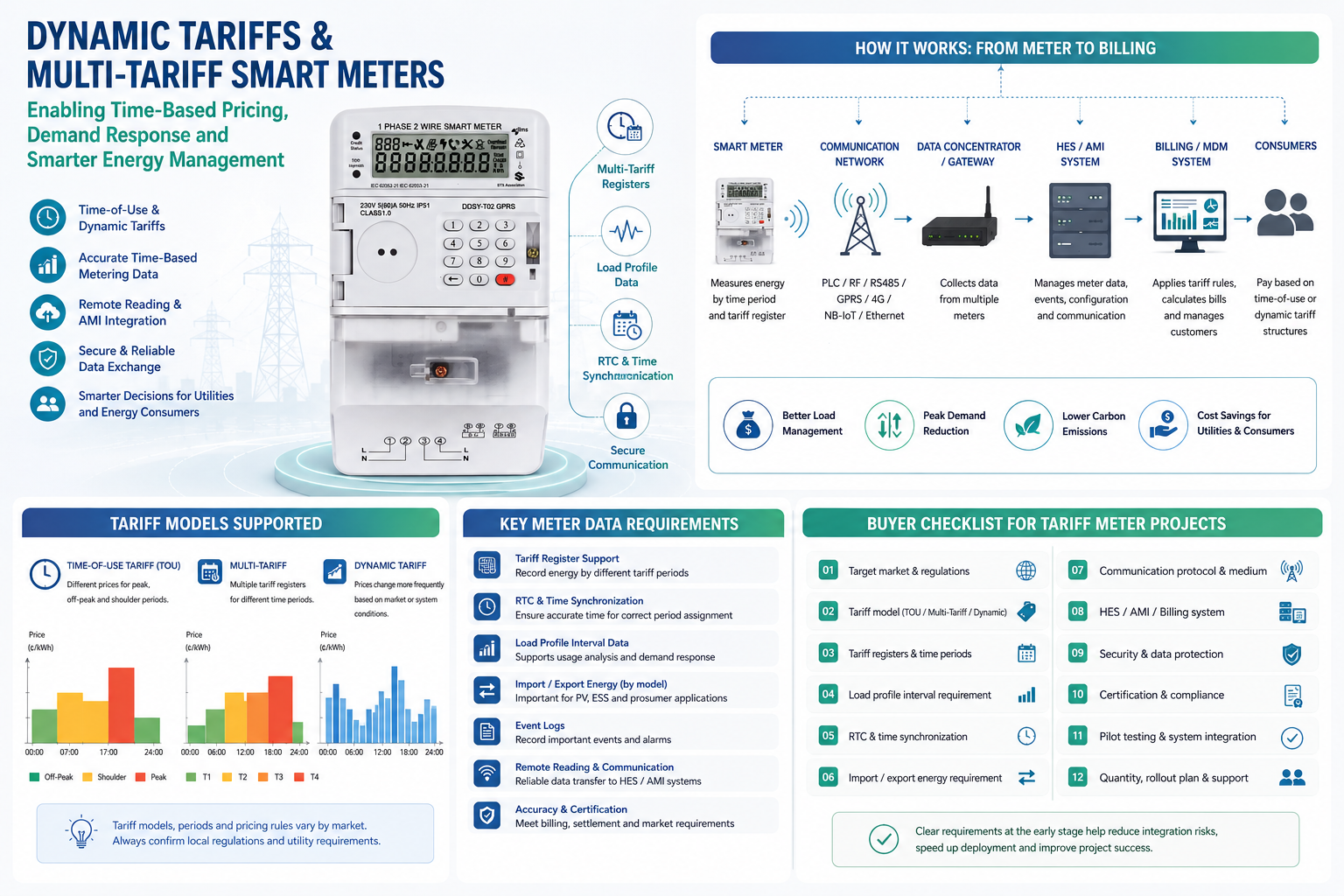
Key data requirements may include:
| Requirement | Why It Matters |
| Tariff register support | Needed for different price periods |
| RTC or time synchronization | Helps assign consumption to correct time periods |
| Load profile interval | Important for demand response and usage analysis |
| Accuracy class | Important for billing or settlement-related applications |
| Import/export measurement | Useful for PV, ESS or prosumer applications |
| Event logs | Helps review configuration, tamper or communication events |
| Remote reading | Needed for AMI or utility projects |
| Communication protocol | Must match HES, concentrator or billing system |
Communication is especially important. A meter may support multiple tariff registers locally, but if the data cannot be read correctly by the HES, AMI platform or billing system, the project may still fail at the integration stage.
AMI, Data Concentrators and Utility Billing Systems
In utility-scale AMI projects, multi-tariff metering is usually part of a larger system architecture.
A simplified data flow may look like this:
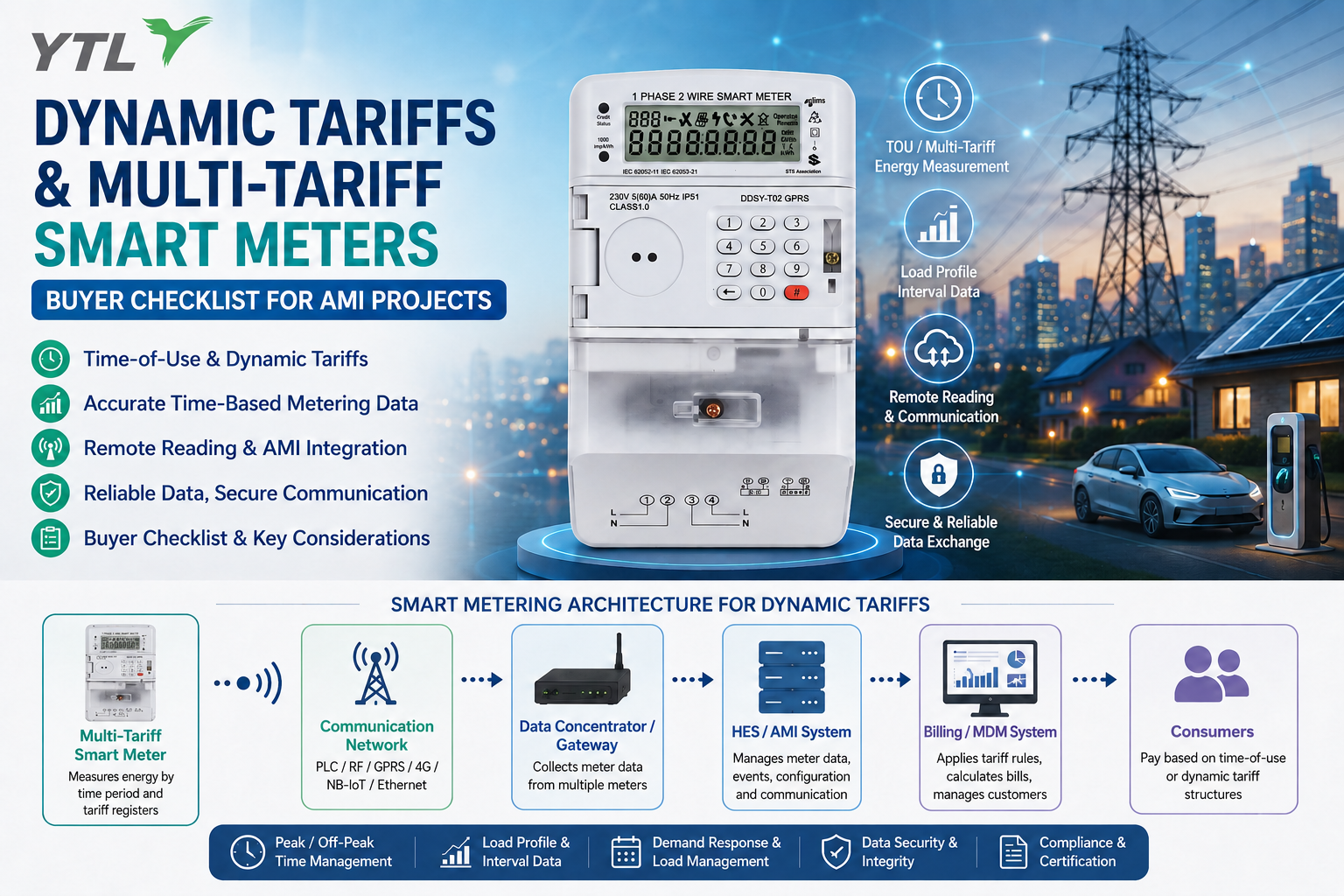
Smart Meter → Communication Network → Data Concentrator / Gateway → HES → Billing / MDM / Utility Platform
The smart meter measures and stores energy data. The communication network transfers data through PLC, RF, RS485, cellular or other methods. A data concentrator or gateway collects data from multiple meters in many AMI designs. The HES manages reading tasks and transfers data to the billing or meter data management system.
For tariff-based projects, buyers should confirm:
- Whether tariff registers can be read by the system
- Whether load profiles match the required interval
- Whether time settings can be synchronized
- Whether the data concentrator supports required meter functions
- Whether the HES can process the selected meter data objects
- Whether billing software can apply local tariff rules
- Whether the communication network remains available in the target market
This final point is important. Some communication technologies, such as GPRS, may depend on local network availability and operator support. Project buyers should confirm the communication environment before selecting a meter or module.
The meter is only one part of the chain. Successful tariff projects require meter, communication network, concentrator, HES and billing system to work together.
Buyer Checklist for Multi-Tariff Smart Meter Selection
Before selecting a multi-tariff smart meter, project buyers should prepare a technical checklist.
| Selection Item | What to Confirm |
| Application | Utility billing, tenant billing, prepaid, AMI or monitoring |
| Tariff type | Time-of-use, multi-tariff, dynamic tariff or prepaid tariff |
| Meter type | Single-phase, three-phase, DIN rail, smart meter or prepaid meter |
| Time function | RTC, time synchronization or system-based tariff logic |
| Data interval | Monthly, daily, hourly, 30-minute, 15-minute or other interval |
| Communication | DLMS, RS485, Modbus, PLC, RF, GPRS, 4G or other |
| System integration | HES, data concentrator, prepaid system or billing platform |
| Certification | Market-specific metering and billing requirements |
| Data security | Authentication, encryption or access control |
| Rollout plan | Pilot testing, batch delivery and long-term support |
A common mistake is asking only whether a meter is a “tariff meter.” A better question is:
Which tariff registers, time functions, communication options, interval data and system integration requirements does this meter support for my target market?
How YTL Can Support Smart Metering Projects
Zhejiang Yongtailong Electronic Co., Ltd. (YTL) manufactures energy metering and power measurement products for smart metering, AMI/AMR, prepaid metering, commercial metering and communication-enabled applications.
For tariff-related smart metering projects, YTL can help buyers evaluate whether the selected meter model supports the required tariff registers, RTC or time synchronization, load profile interval, communication protocol, certification documents and system integration requirements. For selected projects, YTL can also support sample testing, communication option review and OEM/ODM discussion.
Relevant YTL product categories may include:
- Multi-tariff energy meters
- Smart meters
- AMI meters
- DIN rail energy meters
- Prepaid electricity meters
- Data concentrators
- Communication-enabled metering products
However, tariff and billing requirements should be confirmed according to local market rules, selected meter model and utility system requirements. YTL meters should not be described as ready for all dynamic tariff markets or compatible with every billing platform by default.
Selected YTL models may support tariff-related functions, RS485, Modbus, DLMS, PLC, RF, GPRS or other communication options depending on product design, communication module and project requirements. The exact capability should always be confirmed by model, firmware, communication module, certification documents and project specification.
FAQ
What is a multi-tariff smart meter?
A multi-tariff smart meter is a meter that can record or support energy consumption according to different tariff periods or tariff registers, depending on the model and project configuration.
How do smart meters support dynamic electricity tariffs?
Smart meters provide time-based energy data, tariff registers, load profiles or communication output that can be used by utility systems to apply time-of-use or dynamic pricing rules.
Is a multi-tariff meter enough for real-time dynamic pricing?
Usually not by itself. Real-time or frequently changing dynamic tariffs also require time synchronization, interval data, communication with the HES or billing system, and tariff rules defined by the utility or energy supplier.
Can a meter decide electricity prices by itself?
No. The meter provides measurement data and may store tariff-related values. Pricing, billing and settlement rules are usually handled by utility systems, prepaid systems, HES, MDM or billing platforms.
What is the difference between time-of-use and dynamic tariffs?
Time-of-use tariffs usually define fixed price periods such as peak and off-peak. Dynamic tariffs may change more frequently according to market prices or system conditions.
Do dynamic tariff projects require AMI?
Not always, but AMI systems make dynamic or time-based tariff implementation easier because they support remote reading, time-based data collection and integration with billing systems.
What should buyers check before selecting a tariff meter?
Buyers should confirm tariff registers, time functions, load profile interval, communication protocol, HES or billing system compatibility, certification needs and local market rules.
Conclusion
Dynamic electricity pricing, time-of-use tariffs and demand response are making smart meter data more important. As electricity demand grows and power systems require more flexibility, utilities and project buyers need meters that can provide reliable time-based energy data.
A multi-tariff smart meter is not a complete billing platform by itself. Its value is to provide the metering layer for tariff registers, load profiles, remote reading and system integration.
For tariff-related smart metering projects, buyers should evaluate meter type, time function, data interval, communication, HES compatibility, certification and local billing rules before model selection.
Planning a multi-tariff, prepaid or AMI smart metering project? Share your target market, tariff requirement, meter type, communication method, billing system requirement and estimated quantity with YTL. Our team can support model selection, technical confirmation and project-specific metering evaluation.
