









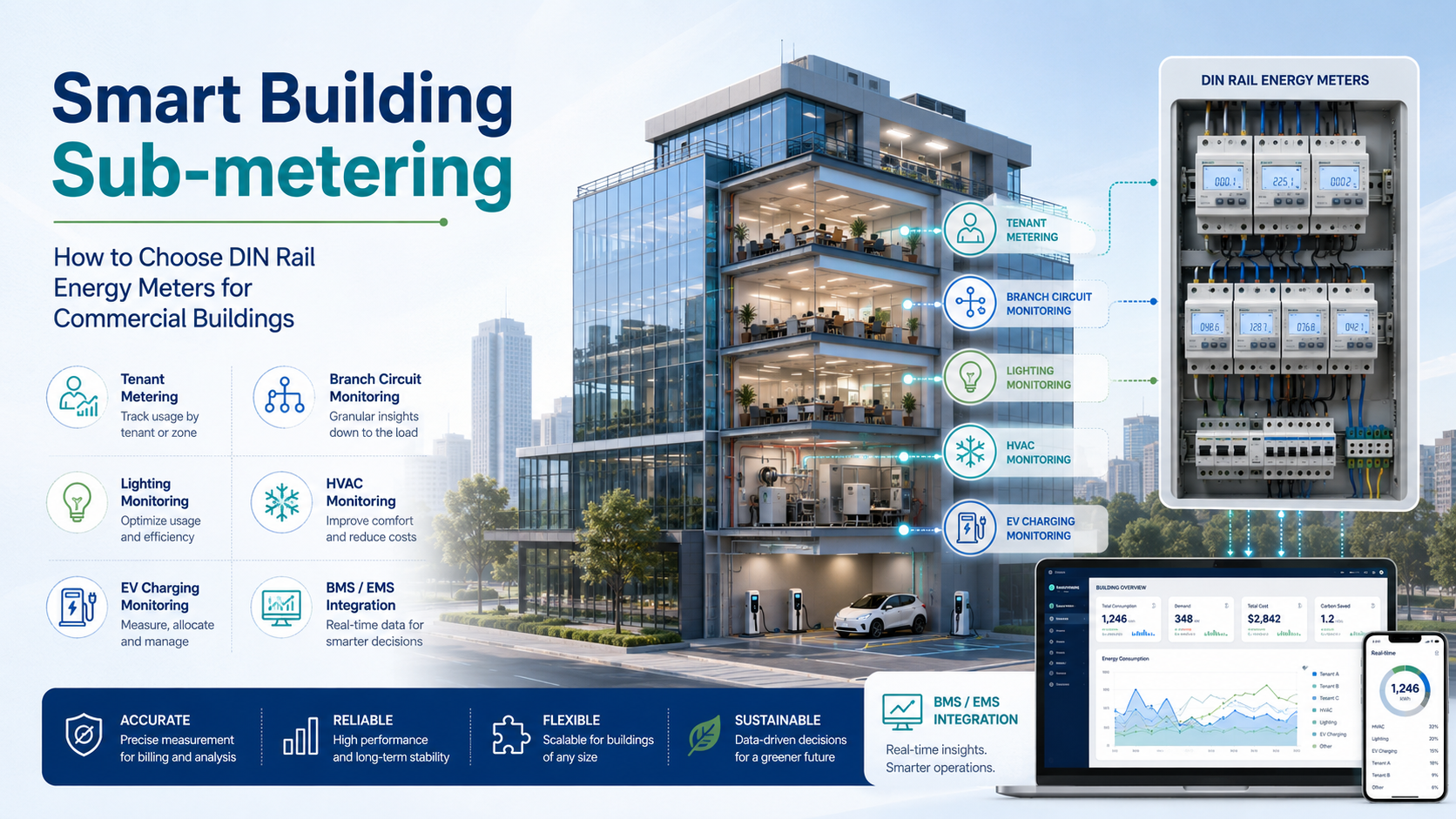
Smart building sub-metering starts with reliable circuit-level electricity data. In commercial buildings, apartments, shopping malls, office buildings and industrial parks, project buyers often need to measure electricity use by tenant, floor, area, equipment or branch circuit.
A DIN rail energy meter can provide kWh measurement, key electrical variables and communication output by model. Before selecting a meter, buyers should confirm the phase type, current range, direct-connected or CT-operated connection, communication requirement, certification documents and whether the meter data will be read by a BMS, EMS, gateway or external system.
The energy meter is not the whole building management platform. Its role is to provide accurate field-level electrical data. When the data is collected by an upper-level system, it can support tenant billing, energy visibility, cost allocation, load analysis and long-term building operation.
Why Smart Buildings Need Sub-metering
In many buildings, a single main meter is not enough to understand how electricity is actually used. Commercial buildings often include different tenants, public areas, HVAC systems, lighting circuits, elevators, pumps, EV charging areas and equipment rooms. Each area may have different load patterns and management requirements.
Without sub-metering, the building owner or facility manager may only see total electricity consumption. This makes it difficult to answer practical questions:
- Which tenant uses the most electricity?
- How much power does each floor consume?
- Are lighting and HVAC circuits operating as expected?
- Which branch circuit shows abnormal load behavior?
- Can electricity costs be allocated fairly between tenants?
Sub-metering helps divide the building into measurable electrical zones. This does not automatically create a complete billing or energy management system, but it provides the data foundation required for those systems to work.
For property owners, sub-metering can support cost allocation. For facility managers, it can support energy analysis. For system integrators, it provides field data for BMS, EMS or remote reading platforms. For tenants, it can make electricity usage more transparent.
Common Metering Points in Commercial Buildings
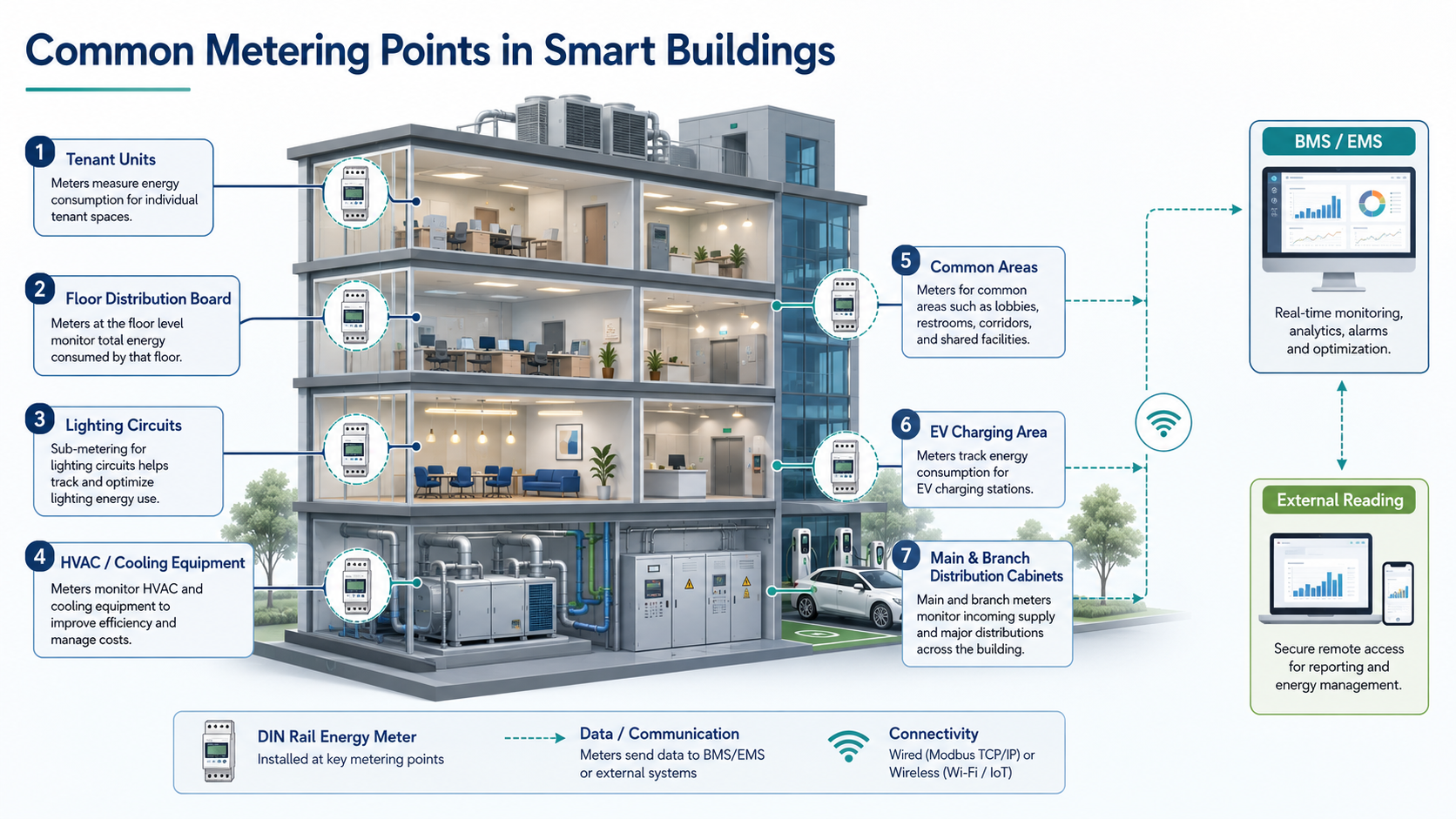
Smart building sub-metering should follow the electrical architecture of the building. A meter should be selected according to the metering point, not only according to product appearance or price.
Common metering points include:
Tenant units
Meters can be installed for apartments, small shops, offices or rented spaces where electricity usage needs to be measured separately.
Floor distribution boards
In office buildings, shopping malls and industrial parks, each floor may have its own distribution board. Three-phase meters are often used when floor-level power data is required.
Lighting circuits
Lighting circuits may be monitored separately, especially in commercial buildings where lighting operation hours affect operating cost.
HVAC and cooling equipment circuits
HVAC systems are often one of the largest electricity consumers in buildings. Metering these circuits can help facility teams understand operating patterns and energy use.
EV charging areas
Commercial buildings increasingly include EV charging spaces. AC input circuits, charging cabinet branches or dedicated charging areas may require separate metering.
Common areas
Corridors, elevators, parking areas, security systems and public lighting may need separate measurement for internal accounting.
Main and branch distribution cabinets
Main distribution and branch circuits provide a clearer view of how power is distributed across the building.
Single-phase vs Three-phase Meter Selection
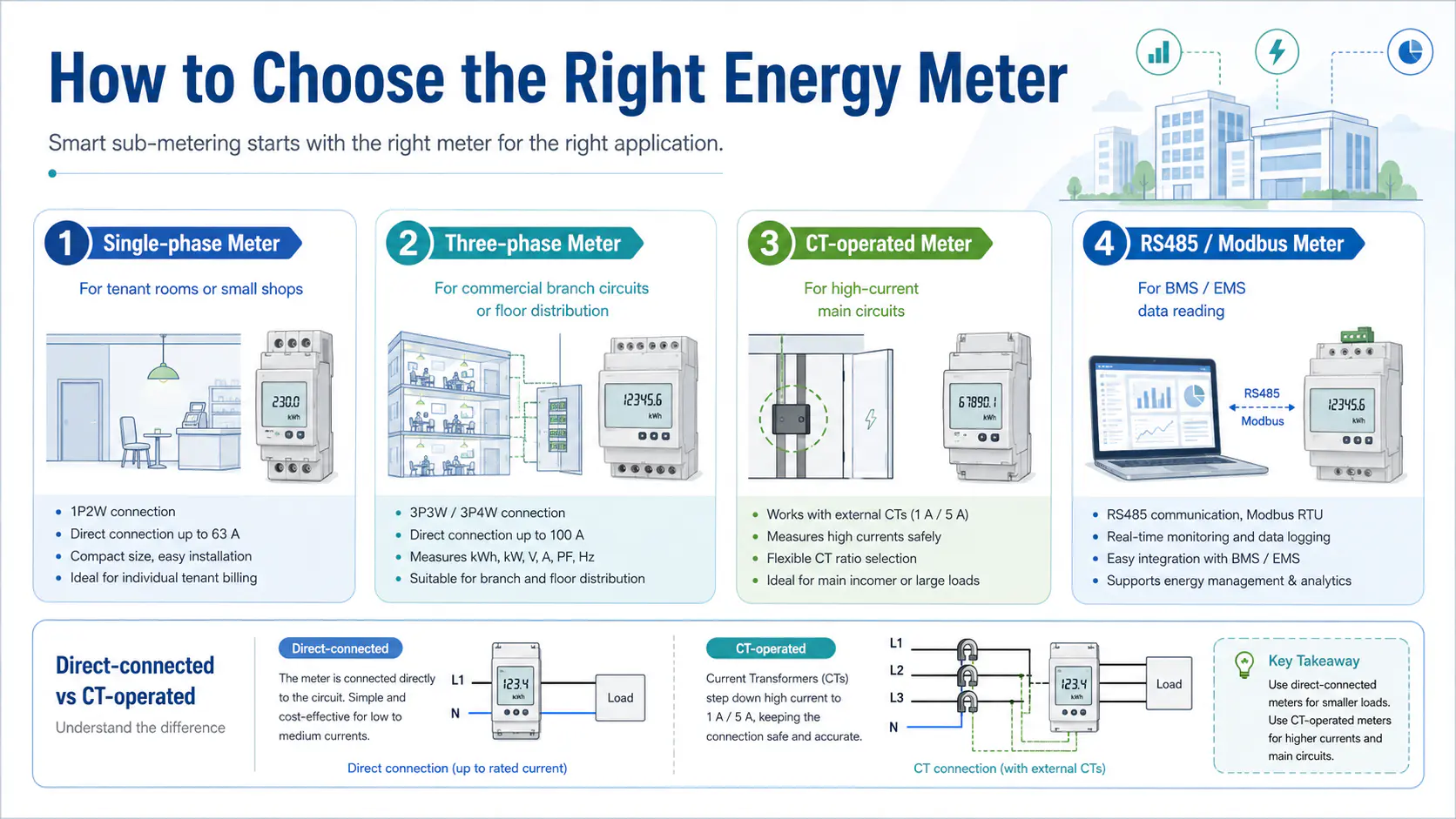
The first selection question is whether the circuit is single-phase or three-phase.
Single-phase DIN rail meters are commonly used for smaller loads, such as apartment rooms, small shops, small office units or single-phase branch circuits. They are compact and suitable for many tenant-level sub-metering applications.
Three-phase DIN rail meters are used for larger loads, commercial branch circuits, floor distribution boards, equipment circuits and three-phase power distribution. They are often required in shopping malls, industrial parks, office buildings and technical equipment areas.
For high-current main circuits, a direct-connected meter may not be suitable. In those cases, CT-operated three-phase meters are usually considered. Current transformers allow the meter to measure high-current circuits indirectly, depending on the selected meter and CT configuration.
A simplified selection logic is:
| Application Scenario | Recommended Meter Type |
| Apartment room or small shop | Single-phase DIN rail meter |
| Small branch circuit | Single-phase or three-phase DIN rail meter |
| Floor distribution board | Three-phase DIN rail meter |
| Commercial equipment circuit | Three-phase meter by load requirement |
| High-current main circuit | CT-operated three-phase meter |
| BMS/EMS data reading | RS485 / Modbus model by series |
| Basic pulse data collection | Pulse output model by series |
Direct-connected vs CT-operated Meters
Direct-connected meters are used when the circuit current is within the meter’s rated input range. They are often easier to install because the load current passes directly through the meter terminals. For many tenant rooms, small commercial units and standard branch circuits, direct-connected DIN rail meters can be a practical choice.
CT-operated meters are used when the circuit current is higher than what a direct-connected meter can handle. In this design, current transformers measure the current and send a secondary signal to the meter. This method is common for main distribution cabinets, high-current three-phase circuits and larger commercial electrical systems.
Before choosing between direct-connected and CT-operated metering, buyers should confirm:
- The expected maximum current
- The circuit voltage and phase type
- Available space inside the cabinet
- Wiring method
- CT ratio, if CT-operated metering is required
- Whether the meter data will be read locally or remotely
The wrong connection method can create installation problems or inaccurate project planning. For this reason, meter selection should start from the actual circuit design.
RS485 / Modbus for BMS or External Reading
Many smart building projects require meter data to be read by a BMS, EMS, gateway, remote reading system or customer-side software platform. In these projects, communication capability is often as important as metering accuracy.
RS485 / Modbus meters can provide data for external reading by selected systems. Depending on the model, a meter may provide data such as:
- kWh energy
- Voltage
- Current
- Active power
- Reactive power
- Apparent power
- Power factor
- Frequency
- Import/export energy by selected model
- Status or alarm data by selected model
However, “Modbus supported” is not enough by itself. Project buyers and system integrators should also check:
- Is the register map clear?
- Can the BMS or EMS read the required values?
- Are communication parameters documented?
- Are baud rate, parity and address settings configurable?
- Will future batches keep the same data structure?
- Is the communication response suitable for the project?
The meter does not replace the BMS or EMS platform. It provides the field-level data that the platform reads, displays, analyzes or uses for reports.
Tenant Billing and Certification Documents
Tenant billing is one of the most common reasons for building sub-metering. In apartments, commercial buildings and industrial parks, the building owner may need to allocate electricity costs to tenants based on actual usage.
For billing-related applications, buyers should confirm whether MID or other market-specific certification documents are required. Certification status varies by product model, destination market and application. A meter that is suitable for monitoring may not automatically be suitable for legal billing in every market.
Before using a meter for billing or cost allocation, buyers should check:
- Accuracy class
- Certification documents
- Local metering rules
- Installation requirements
- Display and reading method
- Whether the system generates bills separately
- Whether the meter data is used for internal allocation or official settlement
This distinction is important. An energy meter can provide measurement data, but billing rules, invoice generation, tariff logic and payment management usually require external software or a management platform.
Recommended YTL Meter Types by Application
Zhejiang Yongtailong Electronic Co., Ltd. (YTL) provides energy metering and power measurement hardware for global B2B projects. For smart building sub-metering, the right product type depends on the actual electrical architecture and data requirement.
| Application | Meter Type |
| Tenant room or small shop | Single-phase DIN rail meter |
| Commercial branch circuit | Single-phase or three-phase DIN rail meter |
| Floor distribution board | Three-phase DIN rail meter |
| High-current main circuit | CT-operated three-phase meter |
| BMS/EMS data reading | RS485 / Modbus model by series |
| Basic pulse data collection | Pulse output model by series |
| Commercial building energy monitoring | Communication-enabled DIN rail meter |
| Industrial park sub-metering | Multi-point meter selection by circuit type |
The selection should not begin only with a model number. It should begin with the metering point, circuit type, current range, communication requirement, certification need and installation condition.
What Energy Meters Can and Cannot Do Alone
To avoid misunderstanding, project teams should clearly separate the role of the meter from the role of the upper-level system.
| Energy Meters Can Provide | Energy Meters Cannot Do Alone |
| kWh measurement | Generate tenant bills automatically |
| Voltage, current and power data | Replace a BMS or EMS platform |
| RS485 / Modbus data output by model | Optimize building energy use automatically |
| Branch circuit measurement | Create complete energy reports without software |
| Direct or CT-operated metering | Manage tariffs or payments by itself |
| Pulse output by model | Replace a remote reading system |
This boundary is important for EPC contractors, system integrators and building owners. The meter provides the measurement layer. The gateway, BMS, EMS or billing platform handles data collection, visualization, analysis, tariff logic and reporting.
Information to Prepare Before Requesting a Meter Recommendation
To help the supplier recommend the right DIN rail energy meter faster, buyers should prepare the following project information:
- Project type: apartment, office building, shopping mall, hotel, factory or industrial park
- Application: tenant billing, sub-metering, monitoring or system integration
- Circuit type: single-phase or three-phase
- Current range
- Direct-connected or CT-operated requirement
- Communication requirement: RS485 / Modbus, pulse output or none
- Certification requirement for the target market
- Installation space inside the cabinet
- Estimated quantity
- Target country or region
With this information, the meter supplier can recommend a more suitable product model and avoid mismatches in wiring, current range, communication or certification.
Why Choose YTL for Smart Building Sub-metering Projects?
YTL focuses on energy metering and power measurement products for commercial, industrial and project-based applications. For smart building sub-metering, YTL can support buyers with product selection across single-phase DIN rail meters, three-phase DIN rail meters, communication-enabled meters and CT-operated metering options.
Project buyers choose YTL for smart building metering projects because YTL can support:
- DIN rail energy meter options for single-phase, three-phase and CT-operated applications
- RS485 / Modbus models for BMS, EMS, gateways and external reading systems
- Metering products for tenant billing, branch circuit measurement and commercial building sub-metering
- Certification and compliance documents by model, target market and application
- OEM/ODM support for project-based energy metering requirements
- Model selection support based on circuit type, current range, communication and installation needs
For billing-related or certified metering applications, buyers should always confirm the exact product model, required certification documents and local market requirements before project selection.
FAQ
What is smart building sub-metering?
Smart building sub-metering means measuring electricity use at specific points inside a building, such as tenant units, floors, equipment circuits, EV charging areas or branch distribution cabinets. It helps provide more detailed energy data than a single main meter.
Which energy meter is suitable for tenant billing?
It depends on the circuit type, current range, accuracy requirement and local certification rules. Single-phase DIN rail meters are often used for small tenant units, while three-phase meters may be used for larger commercial spaces. For billing applications, certification requirements should be confirmed by market and model.
Do smart buildings need single-phase or three-phase meters?
Both may be needed. Single-phase meters are common for small rooms, shops and branch circuits. Three-phase meters are used for larger loads, floor distribution boards, commercial equipment and three-phase circuits.
When should a CT-operated meter be used?
A CT-operated meter should be considered when the circuit current is too high for direct-connected metering. CT-operated meters are commonly used for high-current main circuits and larger three-phase distribution systems.
Can RS485 Modbus meters connect to BMS systems?
Yes, selected RS485 / Modbus energy meters can provide data for BMS, EMS, gateways or external reading systems. Buyers should confirm the register map, communication settings and required data points before integration.
Can an energy meter generate tenant bills automatically?
No. An energy meter provides measurement data. Tenant billing usually requires external software, a billing platform or a building management system to process meter readings, tariffs and payment records.
Do all sub-metering projects require MID certification?
No. Certification requirements depend on the country, application and whether the meter data is used for legal billing, internal allocation or monitoring. Buyers should confirm the required certification documents before selecting a meter.
What is the difference between a sub-meter and a main meter?
A main meter measures the total electricity entering a building or facility. A sub-meter measures electricity use at a smaller level, such as a tenant unit, floor, branch circuit, equipment circuit or common area.
How many Modbus meters can be connected to one RS485 bus?
The number depends on the meter model, communication settings, cable length, installation environment and gateway or controller capability. Buyers should confirm the communication design with the system integrator before installation.
Contact YTL for Model Selection
Choosing DIN rail energy meters for smart building sub-metering requires more than selecting a product from a catalog. Buyers should define the metering point, phase type, current range, connection method, communication requirement and certification needs before choosing a model.
In commercial buildings, apartments, shopping malls, office buildings and industrial parks, DIN rail energy meters can provide circuit-level data for tenant metering, branch circuit monitoring, floor distribution boards, HVAC circuits, EV charging areas and common facilities.
For projects involving BMS, EMS or external reading, RS485 / Modbus capability should be evaluated together with register maps, communication parameters and data point availability. For billing-related applications, certification documents and local market requirements should be confirmed carefully.
Reliable smart building energy management starts from reliable field-level metering data. The right energy meter helps project teams measure electricity clearly, integrate data more smoothly and build a stronger foundation for long-term building operation.
Need a DIN rail energy meter for smart building sub-metering? Contact YTL with your project type, circuit information, communication requirement, certification need and target market for model selection support.
