









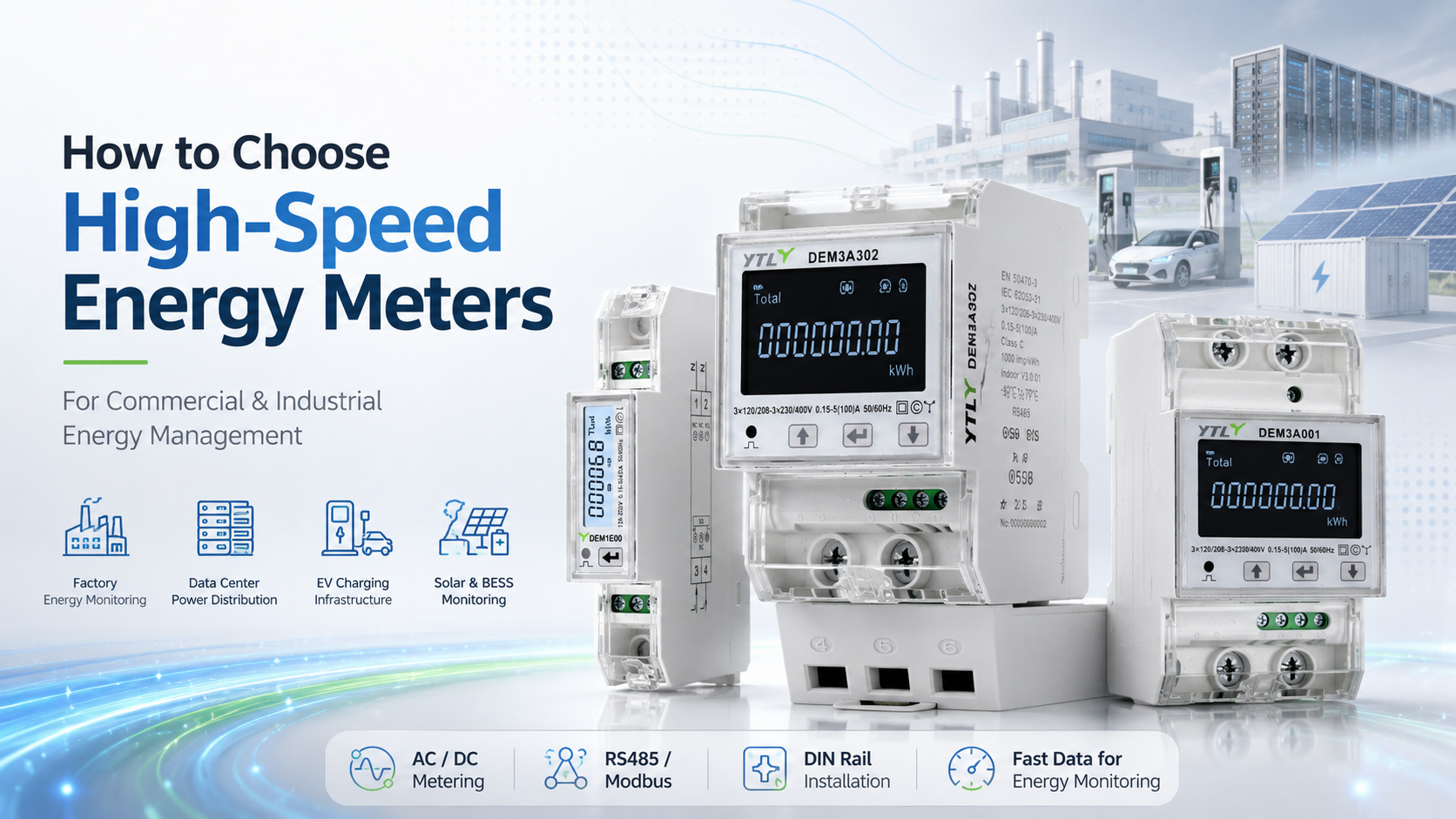
Commercial and industrial energy users are paying closer attention to how electricity is measured, monitored and managed. Rising electricity demand, electrification, electric vehicle charging, solar-storage systems, data centers and stricter efficiency expectations are changing the way companies evaluate metering hardware.
According to the International Energy Agency, electricity demand is expected to grow strongly through 2030, driven by industrial electrification, electric vehicles, air conditioning, data centers and AI-related infrastructure. The IEA also notes that electricity demand is growing much faster than overall energy demand, which increases the need for investment in grids, flexibility and better energy visibility. For industrial facilities, systematic energy management can create measurable savings: IEA analysis of more than 300 energy management case studies in 40 countries found an average energy saving of around 11% in the first years of implementation.
In this context, the energy meter is becoming more than a basic kWh reading device. A high-speed energy meter is not a complete energy management platform by itself. But it is often the first field-level data source that supports energy visibility, load analysis, cost allocation, remote reading and integration with EMS, BMS, SCADA, DCIM or other monitoring platforms.
What Is a High-Speed Energy Meter?
A high-speed energy meter is designed to provide faster measurement response and more frequent data availability than a traditional basic meter. In commercial and industrial projects, this matters when loads change quickly, when multiple circuits need to be monitored, or when meter data must be read by an external system.
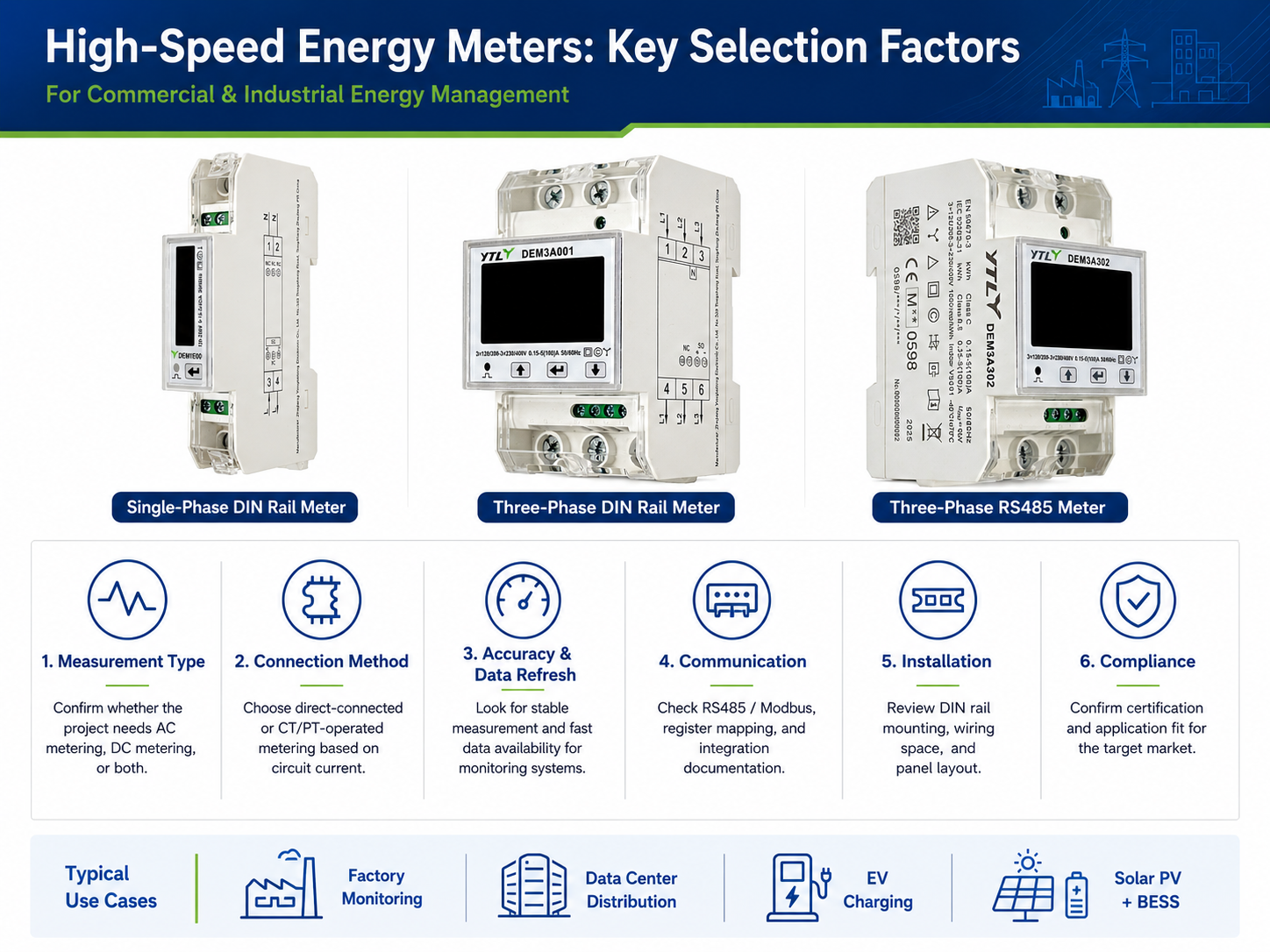
For example, a three-phase direct-connected DIN rail meter such as the DEM3A series is designed for high-speed AC metering scenarios including photovoltaic systems, energy storage systems, factory energy monitoring and outdoor EV charging cabinet applications. The DEM3A302 and DEM3A202 versions support RS485 communication compatible with Modbus RTU and DL/T645-2007, with communication response time up to 75 ms. The DEM3A001 version provides SO pulse output for projects where pulse-based reading is required. The series supports direct connection, 3 × 120/208 V to 3 × 230/400 V rated voltage, 50/60 Hz frequency, 5 A basic current and up to 100 A maximum current.
This type of parameter detail is important because “high-speed” should not only be treated as a marketing word. Buyers should check the actual current range, voltage range, communication response, data points, wiring method, installation size and environmental performance before selecting a meter.
Why Commercial and Industrial Projects Need Better Metering Data
In many C&I energy management projects, electricity is no longer measured only at the main incoming point. Project teams often need data from production lines, distribution cabinets, branch circuits, tenant areas, EV chargers, cooling loads, UPS output circuits and solar-storage systems.
Energy cost pressure is one driver. Without circuit-level data, energy-saving decisions are often based on assumptions rather than measurable evidence. Renewable energy and storage also add complexity because solar PV generation, battery charging and discharging, grid import/export and load-side consumption may all need separate measurement points.
EV charging infrastructure adds another layer of demand. Charging loads are often dynamic, and project teams may need AC input metering, charger branch metering, cabinet-level monitoring or platform-readable data. In data centers, branch-level and cabinet-level power data can support visibility for UPS output, cooling systems, auxiliary loads and distribution circuits. The IEA projects that global data center electricity consumption could double to around 945 TWh by 2030, making reliable power monitoring increasingly relevant for operators and electrical teams.
Key Applications of High-Speed Energy Meters
1. Factory Production Line Monitoring
Factories often include multiple production lines, machines, compressors, pumps and auxiliary systems. High-speed meters can help measure energy use at line level or equipment group level. This allows facility teams to compare consumption, identify abnormal load patterns and support internal cost allocation.
A meter used in this scenario should not only measure kWh. It should also provide practical electrical variables such as voltage, current, active power, reactive power, apparent power, frequency and power factor. According to the DEM3A documentation, the meter can monitor energy consumption, major electrical variables including active/reactive power and power factor, and calculate current/voltage harmonic content and apparent energy.
2. Data Center AC Distribution Monitoring
Data centers require stable and transparent electrical data. High-speed DIN rail meters can be installed in AC distribution cabinets, branch circuits, auxiliary circuits or selected equipment circuits. The meter does not replace a DCIM platform, but it can provide field-level data that DCIM or BMS platforms may use for monitoring and analysis.
For cabinet installation, details such as size and wiring space matter. The DEM3A series uses DIN rail installation and a compact 54 mm × 94 mm × 62.4 mm housing, which is relevant for distribution boards and space-limited electrical panels.
3. EV Charging Station Metering
EV charging projects often involve dynamic loads and communication requirements. Depending on system design, meters may be used on AC input circuits, charger branches or distribution panels. Project teams should clearly distinguish meter data, charger controller data and platform data.
For outdoor charging cabinets, environmental capability is important. The DEM3A series supports a wide operating temperature range from -40°C to +70°C, with relative humidity up to 95% non-condensing. It also requires installation inside a suitable cabinet, such as IP54 for outdoor use or IP51 for indoor use, according to the product documentation.
4. Solar PV and BESS Monitoring
Solar-storage systems may require metering at the grid connection point, inverter output, load side or distribution cabinet. High-speed AC meters can support better visibility of grid import/export, PV output and load-side consumption. However, the meter provides field data; EMS or SCADA platforms remain responsible for analysis, control and optimization.
For solar-storage projects, multiple metering modes can be useful. The DEM3A documentation lists forward plus reverse absolute value, forward minus reverse algebraic sum, forward metering, reverse metering and forward/reverse offset calculation modes. This helps buyers evaluate whether the meter’s data logic matches the project’s reporting and platform requirements.
What to Check Before Selecting a High-Speed Energy Meter
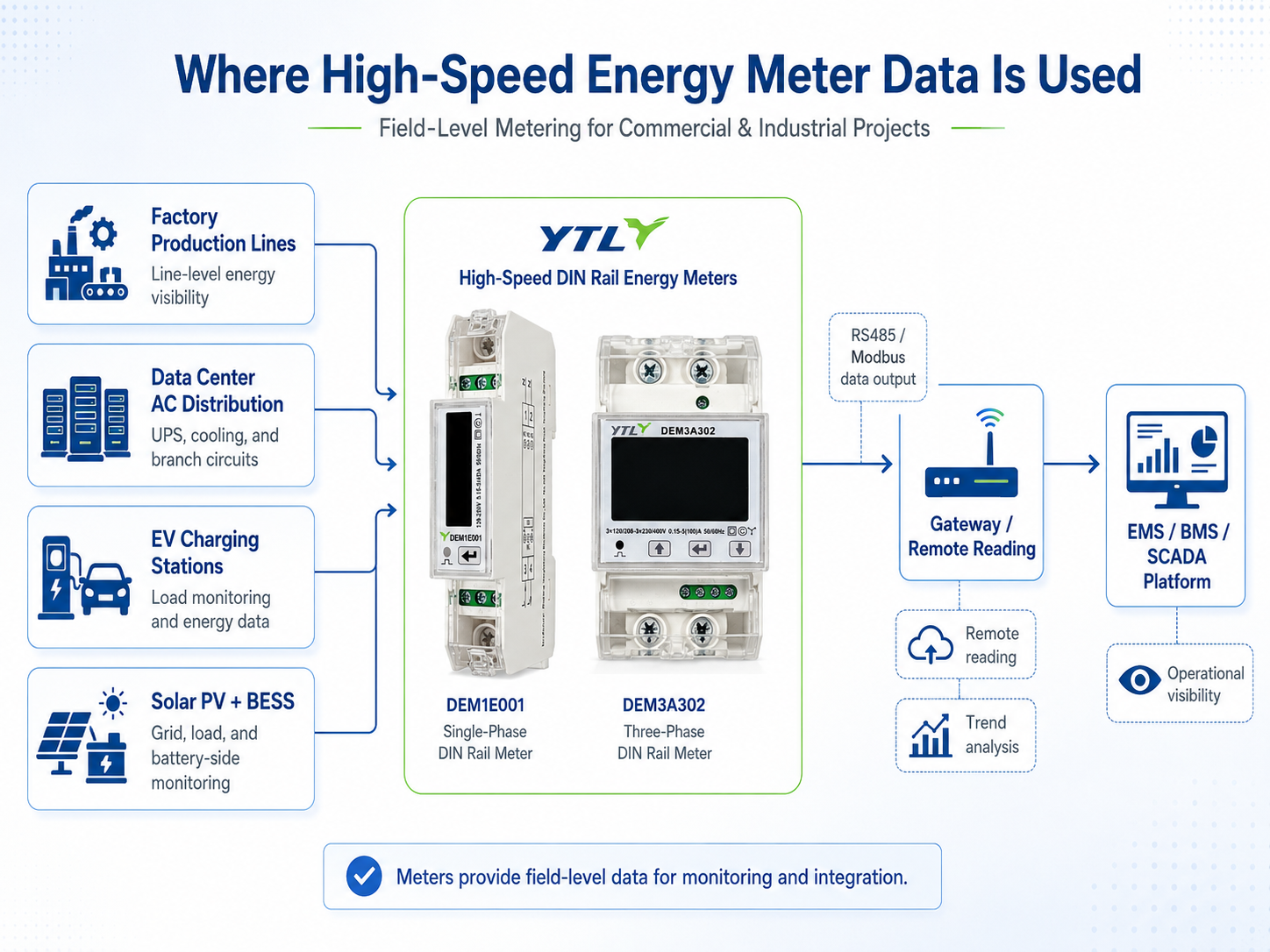
Choosing a meter only by price or appearance can create integration problems later. Project teams should evaluate the following points before procurement.
First, confirm the measurement type. Does the project need AC metering, DC metering or both? AC distribution, EV charging input, industrial panels and data center circuits usually require AC meters, while battery systems or DC cabinets may require DC meters.
Second, check the connection method. For a direct-connected three-phase meter, buyers should confirm maximum current, rated voltage, wiring method and terminal capacity. For high-current circuits beyond direct connection, CT/PT-operated meters may be more suitable.
Third, review accuracy and response. Accuracy class matters, but so does refresh and communication speed. The DEM3A series specifies ±0.5% for voltage, current, frequency, active power and reactive power measurement, Class 0.5 active energy and Class 1 reactive energy, with LCD refresh at 500 ms and communication response up to 75 ms.
Fourth, do not stop at “RS485 / Modbus supported.” Buyers should check the register map, available data points, address range, baud rate options and parity settings. DEM3A RS485 parameters include Modbus address 1–247, baud rates of 9.6/19.2/38.4/57.6/115.2 kbps, and none/odd/even parity settings.
Finally, confirm certification and market requirements. Standards such as IEC 62052-11, IEC 62053-21, IEC 62053-23 and EN 50470-3 may be relevant depending on the application. MID or other certification requirements should always be checked according to selected model, certificate scope, destination market and project use case.
Conclusion
A high-speed energy meter should be selected according to the real circuit, installation method, communication requirement and project objective. In C&I energy management, EV charging, solar-storage and data center applications, its value is not only accurate measurement. Its value is whether the data can be read clearly, refreshed fast enough, integrated reliably and used consistently across real deployments.
YTL focuses on energy metering and power measurement hardware for global B2B projects. A high-speed meter provides accurate, readable, and reliable field-level data. When integrated with gateways, remote reading systems, EMS, BMS, SCADA, or energy analysis platforms, this data enhances visibility, supports informed decision-making, and reduces integration risks.Reliable energy management starts from reliable metering hardware — and reliable metering starts from the right measurement point.
FAQ
- What is the typical refresh rate of high-speed energy meters like DEM3A series?
The DEM3A series supports 75 ms for RS485/Modbus communication, ensuring fast and reliable measurement data for dynamic loads in industrial, EV charging, and data center applications. - 2. How do I ensure compatibility with my EMS, BMS or SCADA platform?
Check the communication protocol, register map, supported data points, baud rate, parity, and addressing. The DEM3A series supports standard RS485/Modbus RTU, with detailed documentation for easy integration. - 3. What certifications should I consider when selecting a high-speed energy meter?
Industrial and commercial projects may require IEC 62052-11, IEC 62053-21, IEC 62053-23, EN 50470-3, or MID compliance. Always verify that the selected model meets the target market and project-specific certification requirements. - 4. Can these meters be used for EV charging billing and load management?
High-speed meters can provide precise kWh, voltage, current, active/reactive power, and pulse output for EV chargers. They can support load monitoring, load balancing, and energy billing when combined with EMS or energy management platforms.
