
 English
 简体中文




Two very different buyers end up searching for the same product. A utility accountant wants to shrink the pile of unpaid electricity bills, and a landlord managing thirty rental flats wants to stop arguing with tenants about money every month. For both, the answer is a single-phase prepayment meter: a meter that collects payment before the power flows. It turns electricity into a prepaid commodity, removes collection disputes at their source, and protects revenue without adding meter-reading or debt-collection staff. For the large majority of residential and small commercial connections, it delivers all of this without changing the existing single-phase supply.
What Is a Single-Phase Prepayment Meter?
A single-phase prepayment meter is an electricity meter that combines measurement, credit management, and a disconnect relay in one single-phase, two-wire unit. The operating rule is simple: the consumer buys credit first, and the meter subtracts that credit as energy is consumed. When the balance reaches zero, the internal relay opens and interrupts the supply. After new credit is loaded, the supply restores automatically. If the distinction between prepaid and post-paid metering is new to you, start with our explainer on what a single-phase prepayment meter is before comparing suppliers.
The metering core works exactly like any electronic single-phase energy meter: current sensing through a shunt or small transformer, voltage measurement through a resistive divider, and a metering chip that calculates active energy. Prepayment firmware adds credit accounting, load-control logic, event logging, and a payment interface. That addition is what changes a simple kWh counter into a revenue collection device.
How Does Payment-Before-Use Metering Work?
The workflow follows a fixed sequence, and most of its value comes from the fact that nobody has to visit the building after installation.
- The customer buys credit from a vending station, an agent, an SMS service, or a mobile app.
- The vending system generates a secure payment token using the meter's unique identifier.
- The customer enters the token through the meter keypad or a remote interface.
- The meter validates the token, credits the balance, and continues metering.
- When the balance reaches zero, the relay disconnects the load automatically.
Most internationally traded prepayment meters follow the Standard Transfer Specification (STS), defined in IEC 62055-41 for the token algorithm and IEC 62055-51 for meter-side decoding. STS matters because it makes tokens interoperable: a token produced by one vending platform works on any STS-compliant meter. Utilities can therefore change meter suppliers without reissuing tokens or replacing installed stock, which is hard to overstate in long-term field operation.
Keypad or Split Configuration
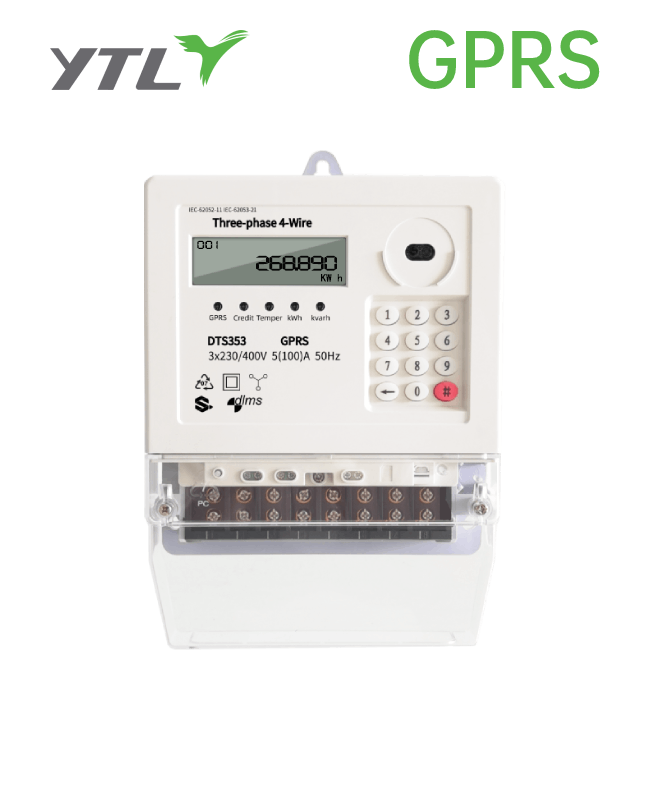
Two physical configurations dominate the single-phase market. Keypad meters integrate the number pad on the meter body, which keeps hardware simple and first cost low, and suits installations where the meter is accessible to the user. Split meters put the display and keypad in a separate Customer Interface Unit (CIU) mounted inside the premises, while the meter body and relay stay behind a sealed enclosure. Split designs are preferred when tamper resistance is a priority, because the customer never reaches the current-carrying section. Many modern prepayment meters also support load limiting: the relay can restrict or cut the supply when demand exceeds a configurable threshold, protecting both the wiring and the distribution transformer.
Key Specifications to Evaluate
The right specification starts with the supply system, not with the brochure. These parameters determine whether the meter performs reliably over a ten- to fifteen-year service life.
| Parameter | Typical value | Why it matters |
|---|---|---|
| System voltage | 230 V ±20%, 50/60 Hz; 120 V variants exist | Must match the grid voltage and its fluctuation band |
| Rated current | 5(60) A, 5(80) A, or 10(100) A | The bracketed figure is the maximum continuous current |
| Accuracy class | Class 1 or Class 2 to IEC 62053-21; Class B to MID | Higher accuracy means less unmeasured consumption |
| Token standard | STS to IEC 62055-41/51 | Guarantees the token is accepted by any STS-compliant meter |
| Communication | Infrared, RS485, RF, PLC, Wi-Fi, 4G | Defines remote reading, top-up, and load-management capability |
| Interface type | Keypad, split CIU, or smart prepaid | Balances customer convenience against tamper security |
Accuracy class deserves a closer look because it has a direct financial meaning. A Class 2 meter may under-record consumption by up to 2% under rated conditions, while a Class 1 meter halves that tolerance to 1%. On a district portfolio consuming tens of gigawatt-hours per year, that difference determines whether the metering investment pays for itself.
When a Single-Phase Meter Is Not Enough
A single-phase prepayment meter is the correct choice below roughly 100 A of connected load on a standard two-wire supply. Projects that move to three-phase service, such as larger shops, offices, or light-industrial workshops, need a three-phase prepayment meter instead. Table 2 provides a quick orientation.
| Criterion | Single-phase prepayment | Three-phase prepayment |
|---|---|---|
| Wiring | 1-phase, 2-wire | 3-phase, 3- or 4-wire |
| Typical voltage | 230 V | 400 V line-to-line |
| Typical applications | Homes, flats, small shops | Commercial buildings, workshops |
| Metering mode | Whole-current up to about 100 A | Whole-current or CT-operated for higher loads |
Why Stakeholders Prefer Prepayment
The commercial case is revenue certainty, and the operational case is simplicity. Both rest on a set of concrete effects that are visible within the first billing cycles.
- Collection overhead falls: there are no monthly invoices to issue and no overdue accounts to chase, because credit is purchased before consumption.
- Unpaid consumption disappears: the supply stops at zero balance, so debt cannot accumulate beyond the credit already loaded.
- Working capital improves: distributors and utilities receive cash before the energy is used, not thirty to sixty days later.
- Tamper events become visible: modern meters log cover openings, magnetic influence, and neutral disconnection, making fraud detectable.
- Consumers gain control: tenants and small businesses see their balance and can budget electricity like any other prepaid commodity.
- Top-up channels scale: mobile money, bank transfer, and app-based vending remove the need for a physical collection office.
How to Choose a Single-Phase Prepayment Meter for Your Project
Select with the whole system in mind. The meter is only one component of a chain that also includes vending software, token generation, installation practice, and after-sales support.
- Confirm the supply parameters: phase, voltage, frequency, and earthing arrangement at the point of installation.
- Estimate the maximum continuous current, add margin for future loads, and choose a bracketed rating such as 5(80) A or 10(100) A.
- Decide between STS prepayment and a proprietary system; STS keeps the freedom to change meter models without changing the vending infrastructure.
- Choose the user interface: keypad for low hardware cost, split CIU where exposed metering increases tampering risk.
- Select the communication option that fits the reading and management plan; even a non-connected meter can start prepaid and migrate later.
- Verify certifications: IEC 62053-21 for accuracy, MID where European approval is needed, and IDIS or other utility requirements where tender documents demand them.
- Review the environmental rating, because tropical sunlight, humidity, and unheated corridors all change the operating-temperature requirement.
- Check the supply package: protocol documentation, vending integration support, warranty terms, and spare-part availability matter as much as the hardware price.
Work with a Manufacturer That Understands Prepaid Projects
Prepayment projects live or die on integration. The meter, the vending software, the token format, and the installation team must agree with each other before the first unit is installed. Procurement conversations therefore work best with a manufacturer that has already built, certified, and shipped the exact combination a project needs.
Manufacturers such as Zhejiang Yongtailong (YTL) produce single-phase prepayment meters in keypad and split configurations, with STS compliance and optional communication modules, and supply utilities, housing developers, and system integrators worldwide. If you are ready to define your requirements, contact the manufacturer directly before the design is frozen; vending and communication choices are far easier to adjust during specification than after mass production begins.
The decision path is straightforward. If you meter single-phase residential or small commercial connections and want to collect revenue before the electricity is used, a single-phase prepayment meter is a proven, standards-supported answer. Define your supply parameters first, choose between keypad and split configurations, verify STS compliance, and select a manufacturer with the certifications, track record, and support capacity to keep those meters running in the field for a decade or more. Get those four steps right, and the prepayment project will pay for itself within the first billing cycles.