
 English
 简体中文
简体中文



1. Introduction to Modern Energy Metering Infrastructure
The evolution of electrical infrastructure has transformed the humble energy meter from a simple recording device into a sophisticated data hub. For industrial manufacturers and global exporters, understanding the technical nuances between different metering architectures is critical for ensuring grid stability and revenue protection. An electric meter, at its core, is a precision instrument designed to measure the amount of electrical energy consumed by a residence, business, or electrically powered device. As global energy markets shift toward decentralized power generation and smart grids, the selection of the correct metering technology—whether for a simple residential billing application or a complex industrial power monitoring system—requires a deep dive into electrical phases, measurement accuracy, and communication protocols.
2. Understanding Phase Architectures: Single-Phase vs. Three-Phase
The most fundamental classification of electric meters is based on the wiring system they support. This distinction is dictated by the load requirements of the end-user and the distribution characteristics of the local power grid.
Single-Phase Energy Meters
Single-phase meters are predominantly utilized in residential settings and small commercial environments. They operate on a two-wire alternating current (AC) circuit, typically consisting of one live wire (phase) and one neutral wire. These meters are engineered to handle lower power capacities, generally suitable for loads up to 10–15 kW. In the B2B export market, single-phase meters are high-volume products often integrated into urban residential development projects.
Three-Phase Energy Meters
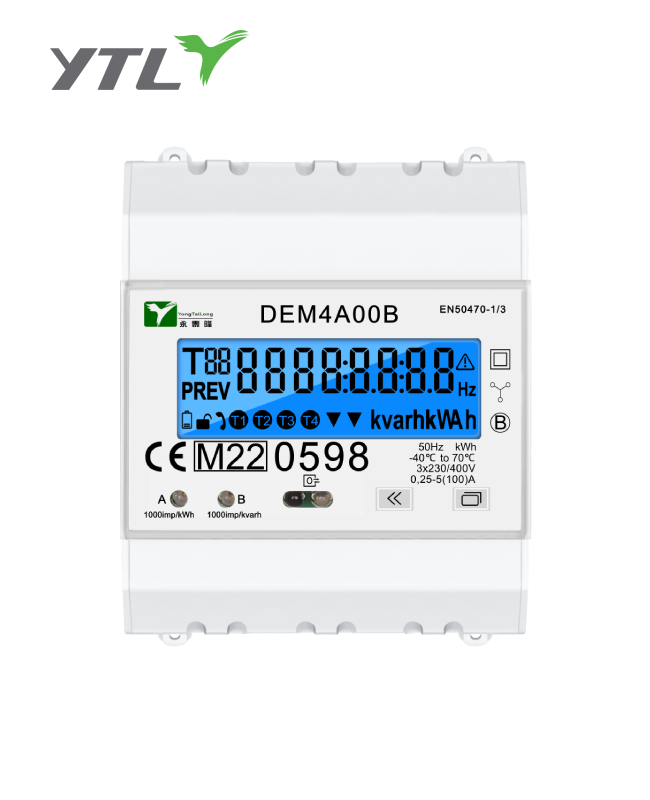
In contrast, three-phase energy meters are the backbone of industrial and large-scale commercial operations. They are designed for three-wire or four-wire systems, providing a more stable and efficient power delivery for high-consumption equipment such as industrial motors, HVAC systems, and manufacturing machinery. Three-phase systems provide three separate currents that are out of phase with each other, ensuring that power delivery never drops to zero.
Technical Comparison Table: Single-Phase vs. Three-Phase
| Feature | Single-Phase Meter | Three-Phase Meter |
|---|---|---|
| Wiring Configuration | 1 Phase, 2 Wire (L+N) | 3 Phase, 3/4 Wire (L1+L2+L3+N) |
| Standard Voltage | Typically 110V / 220V / 230V | Typically 380V / 400V / 415V |
| Typical Load Capacity | Up to 100A (Direct Connection) | Up to 100A (Direct) or CT Operated |
| Primary Application | Residential, Small Offices | Factories, Data Centers, Hospitals |
| Measurement Parameters | Active Energy (kWh) | Active/Reactive Energy, Demand, Harmonics |
3. From Electromechanical to Electronic: The Accuracy Revolution
Historically, the industry relied on electromechanical induction meters, recognizable by their rotating aluminum discs. However, the modern B2B market has almost entirely pivoted to electronic (Static) and Smart meters due to their superior performance metrics.
Electromechanical Meters (Analog)
These meters operate using electromagnetic induction. While robust and capable of lasting decades, they suffer from mechanical wear, sensitivity to orientation, and a lack of data logging capabilities. Their accuracy class is typically limited to 2.0.
Electronic Energy Meters (Digital)
Electronic meters use highly integrated circuits (ICs) and digital signal processing (DSP) to calculate energy consumption. They have no moving parts, which eliminates mechanical friction errors. These devices offer much higher accuracy (Class 1.0 or 0.5S) and can measure multiple parameters beyond just kWh, such as voltage (V), current (I), and power factor (PF).
4. The Rise of Smart Metering (AMI) and Communication Protocols
A “Smart Meter” is essentially an electronic meter equipped with Advanced Metering Infrastructure (AMI). The primary differentiator is the ability for two-way communication between the meter and the utility provider.
Key Functional Features of Smart Meters:
- Remote Disconnect/Reconnect: Allows utilities to manage service without on-site visits.
- Anti-Tampering Mechanisms: Sophisticated sensors detect magnetic interference, cover opening, or terminal bypass.
- Multi-Tariff (TOU) Billing: Supports different electricity rates for peak and off-peak hours.
- Load Profiling: High-resolution recording of energy usage patterns at 15 or 30-minute intervals.
Communication Standards in Global Markets
For a manufacturer, the choice of communication module is as vital as the measurement accuracy. Different regions prioritize different protocols:
- PLC (Power Line Communication): Uses existing power lines to transmit data; popular in Europe and parts of Asia.
- RF (Radio Frequency) / LoRaWAN: Ideal for rural areas or places where power line quality is inconsistent.
- NB-IoT / GPRS: Uses cellular networks for high-speed, reliable data transmission, becoming the standard for urban smart city projects.
- RS485 (Modbus): The standard for industrial sub-metering within factories and commercial buildings.
5. Accuracy Classes and International Standards (IEC vs. ANSI)
In the international B2B trade, compliance with global standards is non-negotiable. The two dominant standards are IEC (International Electrotechnical Commission) and ANSI (American National Standards Institute).
Accuracy Class Explained
The “Class” of a meter denotes its maximum permissible error percentage. A Class 1.0 meter has a maximum error of 1% under standard operating conditions. For industrial revenue metering, Class 0.5S or 0.2S (where “S” denotes high accuracy even at light loads) is often required.
Standards Comparison Table
| Standard | Region | Primary Accuracy Metrics | Common Models |
|---|---|---|---|
| IEC 62053-21 | Global / Europe / Asia | Class 1.0 & 2.0 (Active Energy) | Din-rail & Socket types |
| IEC 62053-22 | Global / Industrial | Class 0.2S & 0.5S (Static Meters) | Transformer-rated meters |
| ANSI C12.20 | North America / LatAm | Class 0.1, 0.2, 0.5 | S-Base (Plug-in) Meters |
| MID (2014/32/EU) | European Union | Class A, B, C (Equivalent to 2, 1, 0.5) | All Billing Meters in EU |
6. Installation Considerations: Direct Connection vs. CT/PT Rated
For large-scale industrial projects, the current levels often exceed the physical capacity of the meter’s internal terminals. This is where Current Transformers (CT) and Potential Transformers (PT) become necessary.
- Direct Connection Meters: Typically used for residential and light commercial loads (up to 60A or 100A). The full load current passes directly through the meter.
- CT-Operated Meters: Used for high-current industrial applications. The meter measures a scaled-down version of the current (e.g., 5A secondary current) and applies a multiplier to calculate actual consumption.
- PT-Operated Meters: Used in high-voltage (HV) transmission and distribution networks where voltage must be stepped down to a safe level (e.g., 110V) for the meter to process.
7. Conclusion: Selecting the Right Meter for Your Project
Selecting an electric meter is a balance between technical requirements, environmental conditions, and budget constraints. For residential developments, single-phase smart meters with STS (Standard Transfer Specification) for prepayment are often the most cost-effective solution. However, for industrial facilities looking to optimize energy costs and monitor power quality, a three-phase Class 0.5S meter with Modbus RS485 or NB-IoT connectivity is the professional choice. As a manufacturer, ensuring that your meters meet the specific local grid requirements—whether it is the DLMS/COSEM protocol for data interoperability or MID certification for European billing—is the key to successful international B2B cooperation.
FAQ
Q1: What is the difference between an Active Energy Meter and a Reactive Energy Meter?
Active energy (kWh) is the “real” power that performs work (heating, lighting, motor rotation). Reactive energy (kVARh) is the power used to maintain electromagnetic fields in inductive loads like motors. Industrial users are often billed for reactive power to encourage efficient power factor management.
Q2: Why are Class 0.5S meters preferred over standard Class 0.5 meters?
The “S” suffix stands for “Special.” Class 0.5S meters are designed to maintain high accuracy even at very low currents (as low as 1% of the rated current), whereas standard Class 0.5 meters may only be accurate down to 5% or 10% of the rated current.
Q3: Can a three-phase meter be used for a single-phase load?
Technically, yes. Most modern three-phase electronic meters can measure a single-phase load by connecting only one phase and the neutral. However, this is not cost-effective and is generally only done in specific industrial sub-metering scenarios.
Q4: What is the DLMS/COSEM protocol?
DLMS (Device Language Message Specification) / COSEM (Companion Specification for Energy Metering) is a global standard for smart meter data exchange. It ensures that meters from different manufacturers can communicate with a single central utility software system.
Q5: What is the typical lifespan of an electronic smart meter?
While electromechanical meters could last 30 years, electronic smart meters typically have a design life of 10 to 15 years, primarily limited by the lifespan of the electrolytic capacitors and the battery used for the real-time clock and LCD display.
References
- International Electrotechnical Commission (IEC) 62053-21: Static meters for AC active energy (classes 0.5, 1 and 2).
- ANSI C12.20-2015: American National Standard for Electricity Meters - 0.1, 0.2, and 0.5 Accuracy Classes.
- Smart Metering Infrastructure: Communication Protocols and Security Standards, IEEE Power & Energy Society.
- The Role of AMI in Modern Power Systems, Journal of Electrical Engineering & Technology.
- MID (Measuring Instruments Directive) 2014/32/EU Annex V: Active Electrical Energy Meters.
.png?imageView2/2/w/500/h/500/format/png/q/100 "YTL STS Prepaid Wi-Fine Energy Meter Single Phase Wall")
.png?imageView2/2/w/500/h/500/format/png/q/100 "YTL Two Phase Three Wire Big counter Electricity Meter")
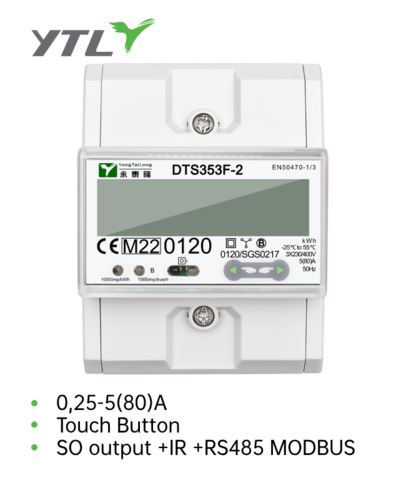
.png?imageView2/2/w/500/h/500/format/png/q/100 "YTL Single Phase Active Electronic Electricity Meter")