
 English
 简体中文
简体中文



In the invisible network of energy flow, an electricity meter acts as a precision timekeeper, recording the energy conversion of every electron migration. Inside this seemingly simple device lies a wealth of interdisciplinary technical expertise and ingenious engineering solutions. From current sampling to data processing, from mechanical transmission to communication, every step embodies the relentless pursuit of accuracy in metrology science.
The Art and Science of Current Sampling
Current measurement is the foundation of energy metrology and the core of technical challenges. Modern electricity meters adopt a variety of distinctive current sampling technologies tailored to different application scenarios and accuracy requirements.
The shunt resistor scheme is favored in many applications for its excellent linearity and cost-effectiveness. The key lies in selecting manganin alloy materials with extremely low temperature coefficients, and eliminating the effects of parasitic inductance and distributed capacitance through clever mechanical structure design. Pairing and calibration of precision resistor networks ensure long-term stability, while special packaging processes isolate interference from ambient humidity.
Current transformer technology shows unique advantages in high-current measurement. The application of nanocrystalline alloy cores greatly improves magnetic permeability, multi-layer winding design optimizes frequency response, and compensation circuits eliminate phase errors. The innovative Rogowski coil solution even enables non-contact measurement, opening up possibilities for special applications.
The introduction of Hall-effect sensors has opened up a new technical path. Closed-loop Hall devices achieve extremely high linearity through feedback mechanisms, integrated design reduces external interference, and digital output formats simplify subsequent processing. This technology is particularly suitable for applications requiring electrical isolation, offering a new option for safe metering.
The Pursuit of Precision in Voltage Measurement
Compared with current measurement, voltage measurement appears simple but is actually complex. Direct voltage divider resistor networks must address long-term stability, while capacitive divider schemes need to balance frequency response and temperature characteristics.
Temperature compensation of precision resistor networks is a key technology. By selecting material combinations with complementary temperature coefficients, designing special circuit layouts to reduce thermal gradients, and adopting active temperature monitoring and digital compensation algorithms, modern electricity meters maintain voltage measurement accuracy over a wide temperature range.
Anti-interference design is equally critical. Multi-layer shielding structures block external electromagnetic interference, filter circuits eliminate high-frequency noise, and digital filtering algorithms enhance signal quality. Together, these measures ensure the purity of voltage measurements, laying a solid foundation for accurate metering.
The Evolution of Power Calculation Algorithms
From analog multipliers to digital signal processors, the evolution of power calculation technology reflects continuous improvements in computational accuracy and flexibility. Early analog multipliers, based on time-division or Hall-effect principles, offered fast response but limited accuracy.
The introduction of digital sampling technology brought a revolutionary change. High-speed analog-to-digital converters synchronously sample voltage and current signals at thousands of hertz, and digital signal processors calculate instantaneous power in real time and integrate it. This scheme not only delivers higher accuracy but also enables advanced functions such as harmonic power analysis.
Advanced algorithms further boost computational performance. Sliding-window filtering smooths measurement noise, adaptive algorithms compensate for sensor nonlinearity, and Fourier analysis achieves spectral decomposition. The implementation of these algorithms relies on continuous improvements in processor performance and in-depth software optimization.
Precise Synchronization of Time References
Time accuracy is critical in time-of-use metering and event logging. Early electricity meters relied on simple crystal oscillator circuits, which had limited accuracy and were highly temperature-sensitive.
The emergence of temperature-compensated crystal oscillators improved performance. With built-in temperature sensors and compensation circuits, these devices maintain frequency stability over a wide temperature range. Oven-controlled crystal oscillators achieve even higher precision through active temperature control, enabling applications requiring accurate timestamps.
External clock synchronization technology has brought a qualitative leap. Multiple synchronization methods—including power-line carrier clock signals, radio broadcast time codes, and satellite navigation system timing—have elevated the time accuracy of electricity meters to unprecedented levels. This precise synchronization not only supports complex tariff strategies but also provides reliable time references for power grid event analysis.
Intelligent Optimization of Power Management
As devices operating continuously for long periods, electricity meters demand critical power supply design. Traditional transformer-powered solutions are reliable but inefficient, while switching power supply technology improves efficiency but poses electromagnetic interference challenges.
The application of energy-harvesting technologies has opened new avenues. Power extraction from current transformers eliminates the need for external power supplies entirely, photovoltaic-assisted power supply performs well in sunlit areas, and thermoelectric generation offers options for special environments. These innovations greatly expand the applicable scenarios of electricity meters.
Intelligent power management further enhances energy efficiency. A multi-level power supply architecture delivers appropriate voltages to different circuit modules, dynamic power regulation adjusts energy consumption based on operating status, and sleep-wake mechanisms minimize power use while retaining basic functions. These technologies allow modern smart electricity meters to offer vastly expanded functionality while significantly reducing their own energy consumption.
Exquisite Mechanical Structure Design
Even in the fully electronic era, mechanical structures remain vital in electricity meters. Enclosure protection design must meet waterproof and dustproof ratings, terminal reliability directly affects installation quality, and fixing structures must withstand mechanical stress during transport and installation.
Material selection reflects a commitment to long-term reliability. Engineering plastics must simultaneously meet strength, flame-retardant, and weather-resistance requirements; metal components are chosen for conductivity, corrosion resistance, and mechanical performance; and sealing materials must retain long-term elasticity without releasing harmful substances.
Installation friendliness is also a design priority. Clear markings guide correct wiring, user-friendly structures facilitate construction, and modular design simplifies maintenance and replacement. These details demonstrate the designers’ deep understanding of usage scenarios and strong focus on user experience.
Comprehensive Consideration of Environmental Adaptability
The diversity of real-world operating environments poses comprehensive challenges to electricity meter design. High-temperature environments require special heat dissipation and heat-resistant materials; high-humidity regions demand enhanced sealing and anti-corrosion treatment; and high-altitude areas must account for the impact of air pressure changes on insulation performance.
Electromagnetic compatibility (EMC) design requires a system-level solution. Optimized circuit layout reduces internal interference, shielding structures block external interference, and filter circuits suppress conducted interference—all must work in harmony to achieve ideal results. Advanced simulation tools predict and resolve potential EMC issues during the design phase.
Long-term reliability verification adheres to stringent testing standards. Accelerated aging tests simulate years of operation, extreme temperature cycling tests material durability, vibration and shock tests verify structural strength, and salt-spray corrosion tests assess environmental adaptability. These tests ensure products operate reliably over the long term under harsh conditions.

Technological Integration of Communication Interfaces
Modern electricity meters feature increasingly diverse communication capabilities, with the integration of wired and wireless technologies providing flexible solutions. Power-line carrier communication uses existing lines without extra wiring, wireless communication supports flexible deployment and rapid networking, and optical fiber communication offers extremely high bandwidth and anti-interference performance.
Protocol compatibility has become a key consideration. Support for multiple international standards and industry specifications, interoperability between devices from different manufacturers, and backward compatibility to protect existing investments—these requirements drive the standardization of communication interfaces. New technologies such as software-defined radio offer new possibilities for protocol flexibility.
Cybersecurity plays a major role in communication design. Encrypted transmission protects data privacy, identity authentication prevents unauthorized access, and integrity checks ensure data accuracy. These security mechanisms are deeply integrated with communication functions, building a trusted data transmission channel.
Intelligent Upgrading of Data Processing
The explosion of data has raised new demands for the data processing capabilities of electricity meters. Edge computing offloads partial processing tasks to terminal devices, reducing data transmission pressure, lowering response latency, and improving system reliability.
The application of machine learning unlocks new possibilities. Abnormal power consumption pattern identification helps detect potential issues, load forecasting supports optimized grid dispatching, and energy efficiency analysis provides personalized energy-saving recommendations. These intelligent functions not only enhance device value but also create new user experiences.
Data compression and optimization technologies address storage and transmission challenges. Intelligent data sampling reduces data volume while retaining key features, lossy compression algorithms balance accuracy loss and efficiency gains, and event-driven transmission sends data only when necessary. These technologies enable smart electricity meters to deliver powerful functions within limited resources.
The evolution of electricity meter technology is a condensed history of precision engineering. Every improvement in measurement accuracy represents a deeper understanding of physical laws; every optimized design detail reflects rigorous engineering thinking; every pioneering technological breakthrough demonstrates the excellence of human ingenuity. In this tiny, sophisticated microcosm, we see not only technological progress but also humanity’s eternal pursuit of accuracy, reliability, and intelligence. As energy systems continue to evolve, electricity meters will surely keep playing their unique role, composing a new movement of metrology science in the symphony of light and data.
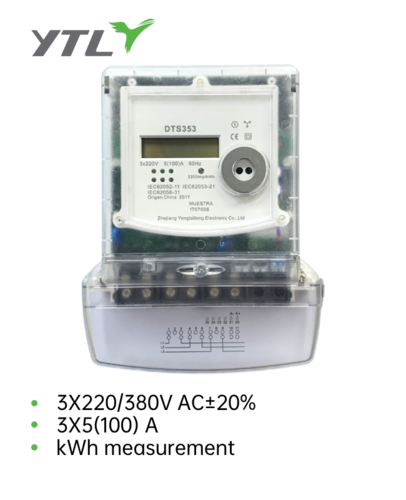
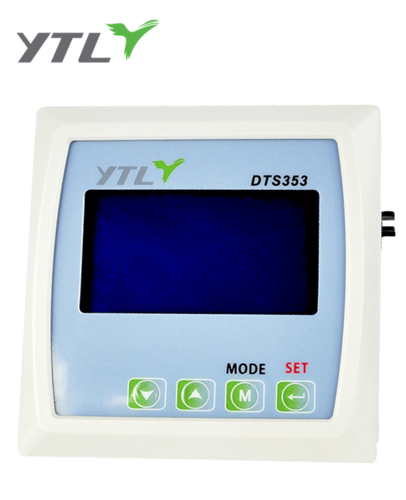
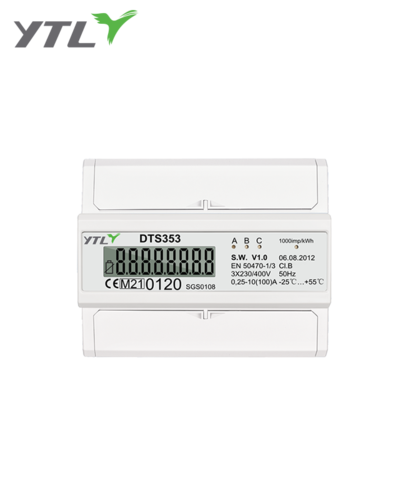
.jpg?imageView2/2/w/500/h/500/format/png/q/100 "YTL Company DTS353C DIN Rail 3P 4 Model Electricity Meter MID")